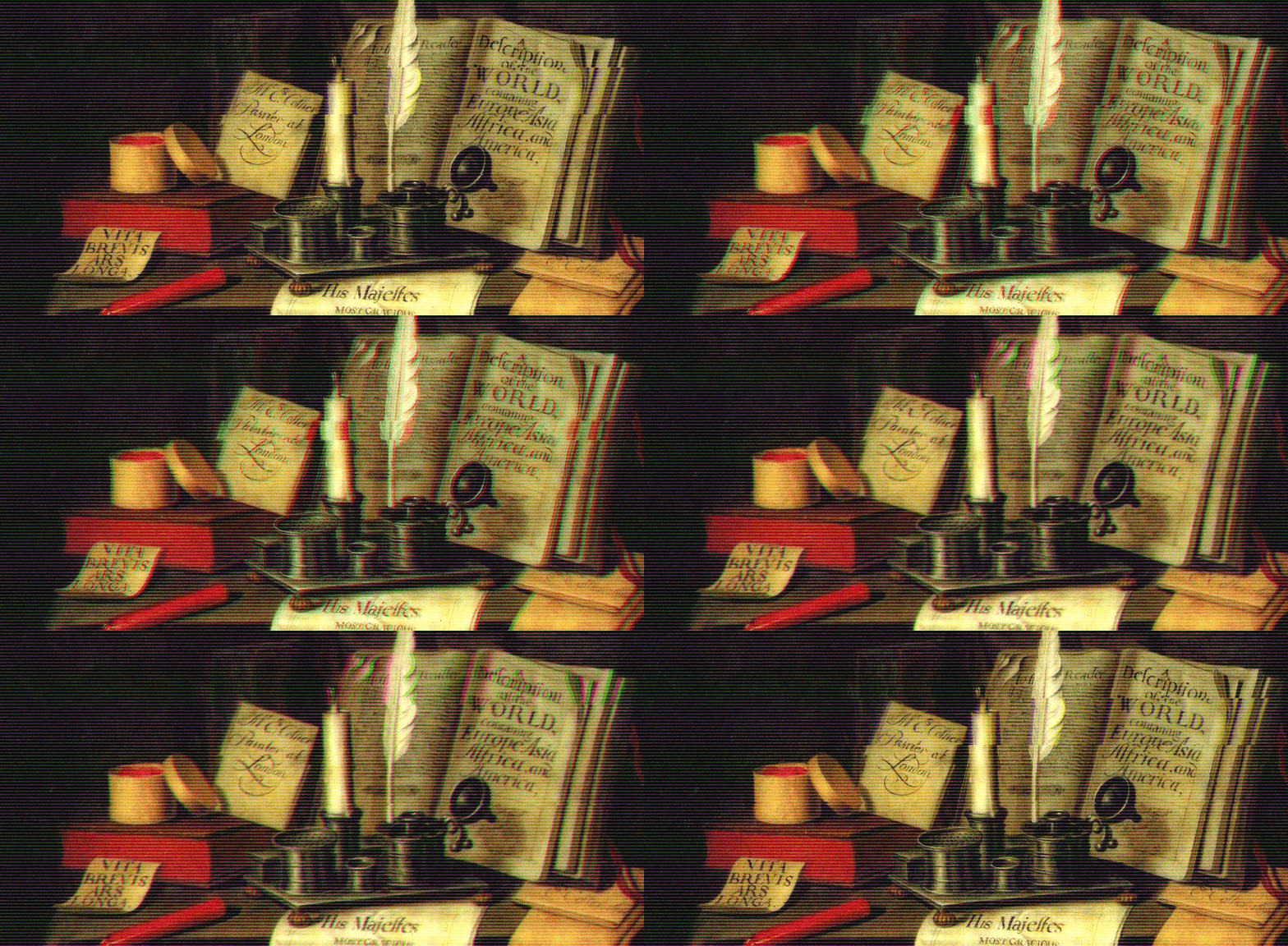
FULMEN QUARTERLY
A seasonal, avant-garde periodical

On Symbolic Thinking
Editorial
Winter, 2022
+
1
Nothing is more irritating than those works which “coordinate” the luxuriant products of a mind that has focused on just about everything except a system. What is the use of giving a so-called coherence to Nietzsche’s ideas, for example, on the pretext that they revolve around a central motif? Nietzsche is a sum of attitudes, and it only diminishes him to comb his work for a will to order, a thirst for unity. A captive of his moods, he recorded their variations. ... The obsession with a system is no less suspect when it is applied to the study of the mystics.
2
The lack of philosophic foundations has given rise to [the] analytical spirit. … [Our] Western scientific thinking has some obvious reasons to refuse the search for causes: The purely cerebral means at its disposal do not allow it. Besides, entering the domain of the “why” of things would have been a matter of small importance to our scientists up to now, as their faith has been staunchly materialistic and mechanistic. Their interest was entirely absorbed by the material sequence of phenomena. … At this time, however, science has been beaten back to the fundamental problem of gravitation. Cosmic energy, undetermined and nonpolarized, will have to be called upon. Then, inevitably, the question will arise: Why? Why? because there exists no “reasonable reason” for a polarization of this cosmic energy. Unless pure faith is accepted as a refuge, a superior form of intellection will necessarily have to be summoned in order to “hear” this understanding.
3
I am referring to the bias displayed by those who regard romances and legends merely as fantastic and poetic human works, whether of an individual or collective authorship; these people deny anything that may have a higher, symbolic value and that cannot be regarded as an arbitrary creation. It is precisely this symbolic, objective, and superindividual element, however, that constitutes the core of sagas, legends, myths, adventurous feats, and epics of the traditional world. This element did not always originate from a perfectly conscious intention.
4
The poet only asks to get his head into the heavens. It’s the logician who seeks to get the heavens into his head. And it is his head that splits.
5
Now these techniques were at the same time mysteries, for, on the one hand, they implied the sacredness of the cosmos, and, on the other, were transmitted by initiation (the craft-secrets).
6
The beauty of a star-shaped figure—a hexagonal star, say—is impaired if we regard it as symmetrical relatively to a given axis.
7
The first ornament invented, the cross, was of erotic origin. The first work of art, the first artistic act, which the first artist scrawled on the wall to give his exuberance vent. A horizontal line: The woman. A vertical line: The man penetrating her. The man who created this felt the same creative urge as Beethoven, he was in the same state of exultation in which Beethoven created the Ninth.
8
The wish to create incessantly is vulgar, betraying jealousy, envy, and ambition. If one is something, one does not actually need to do anything—and nevertheless does a great deal. There is a higher type than the ‘productive’ man.
9
Is there any better sign of civilization than laconism? To stress, to explain, to prove—so many forms of vulgarity.
10
Anything your reader can do for himself leave for him.
end.
1. Emil Cioran, The Temptation to Exist. 1956. translated by Richard Howard. 1968.
2. René Adolphe Schwaller de Lubicz, The Egyptian Miracle: An Introduction to the Wisdom of the Temple. 1963.
3. Julius Evola, The Mystery of the Grail. 1937. translated by Guido Stucco. 1996.
4. Gilbert Keith Chesterton, Orthodoxy. 1908.
5. Mircea Eliade, The Forge and the Crucible: The Origins and Structures of Alchemy. 1956. translated by Stephen Corrin. 1962.
6. Ludwig Wittgenstein, Culture and Value. translated by Peter Winch. 1984.
7. Adolf Loos, Ornament and Crime. 1913. translated by Shaun Whiteside. 2019.
8. Friedrich Nietzsche, Human, All Too Human. 1878. translated by Alexander Harvey. 1908.
9. Emil Cioran, Drawn and Quartered. 1979. translated by Richard Howard 1983.
10. Ludwig Wittgenstein, Culture and Value. 1970. translated by Peter Winch. 1984.
